KEEPING UP WITH KENZ
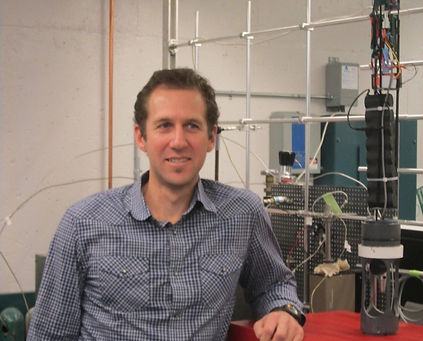
“They’re known to be a pretty important nursery for demersal fish, for fish who spend some of their time out offshore, away from the coast, but have part of their lifecycle within an estuary or within some type of a coastal water body,” said Loose.
Mangrove roots provide fish with various hiding places, which gives them protection from other predators. They are also really important for oyster hatcheries.
In an attempt to restore the Senegal mangroves, volunteers replanted over 100,000,000 mangrove seeds.
“Hopefully, it helps the ecosystem come back to its previous state, in that state, it was a slightly better fishery than it is now,” said Loose. “Rice cultivation was possible over a large region, to a certain degree, it’s going to provide a more stable food supply to the local population.”
Now, Loose wants to manufacture more monitoring instruments and place them in villages across West Africa. So that he can monitor these conditions on a regional level.
Photo Credit: Bradley Labonte
Mangrove Restoration: Changing the Environment
By Bradley Labonte
NARRAGANSETT-Dr. Brice Loose recently made a trip to West Africa to study mangrove estuaries and can now monitor the results back in the states.
While in West Africa, Loose and his colleagues discovered that they had incredible cell phone service. They decided to create a low cost monitoring instrument and tap into the existing communication network, so that they could have a real time data collection back in the states.
“That gave rise to the idea of building this thing, which is just a really simple sensor,” said Loose. “It measures the temperature of the water, the water depth above it and the productivity of the water.”
Right now, Loose is most interested in mangrove restoration in Senegal, West Africa, and plans to do another project there soon. But due to the recent Ebola crisis, any plans of a trip there have been put on hold.
“The goal of this project, in general, is to sort of take what we can contribute and add that to a grassroots movement,” said Loose. “Which is trying to basically bring back an ecosystem from the brink of some pretty serious habitat destruction.”
According to the National Oceanic and Atmospheric Administration, mangroves are trees that grow in areas with low-oxygen soil, where slow moving waters allow fine sediments to accumulate. They only grow at tropical and subtropical latitudes near the equator.